
Can Passengers See the Stop? Nighttime AV HMI Simulation
Vision / Night Visibility / Autonomous Vehicle Safety
I used an exploratory Python model to examine where a safety-critical stop alert may be visible across an autonomous vehicle cabin, and how an assumed night-time glare veil changes display contrast.
Project Objective
A visual cue on a driver-facing head-up display may not reach every passenger. The front dashboard is farther from the rear row, and a HUD has an eye box designed around a driver position. Night conditions add another question: display output must remain visible while glare and window reflections can reduce perceived contrast.
I used the existing AURA route-planning study prototype as the interface reference and reframed it around one safety-critical event: an autonomous vehicle detects an obstruction and begins an emergency stop. The analysis asks how the alert could reach the front and rear rows without asking a person to delay the vehicle's automatic response.
What This Case Study Is
Exploratory modeling
Python calculates sight geometry, apparent display size, and contrast changes under defined assumptions.
Not a human vision experiment
No participants, eye tracking, reaction times, readability scores, or hazard-detection data were collected.
Not a vehicle measurement
The cabin dimensions and screen luminances are illustrative inputs, not measured specifications.
Purpose
Use the model to identify design questions and plan a cabin-mock-up or simulator study.
Scenario and Analysis
Dimensioned Cabin Model
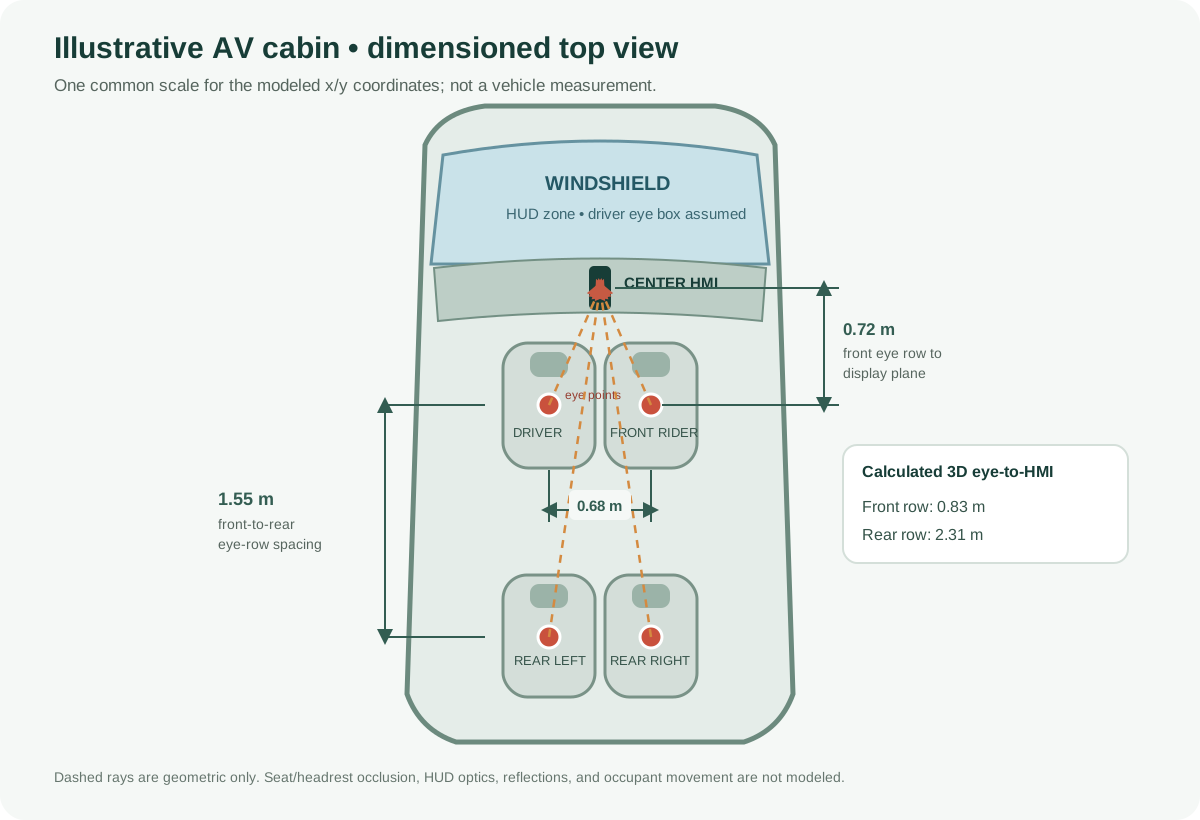
The top view shows the model coordinates. The eye-row spacing is 1.55 m; the front seat eye points are 0.34 m to either side of the centerline. The center HMI is modeled 0.72 m ahead of the front-row eye line. With display and eye height included, the calculated eye-to-screen distance is 0.83 m for the front row and 2.31 m for the rear row.
Geometric Signal
The rear screen is smaller in the visual field because the modeled passengers are farther away. This is not a readability result: the model does not define a legibility threshold, and it does not check whether a seat, passenger, or cabin part blocks the display. HUD virtual distance also cannot be used alone to judge legibility. If the HUD holds the same angular glyph size, that angular size stays constant by design.
Night and High-Beam Sensitivity
The contrast model adds a uniform in-eye veil to the assumed text and background luminance. For the strong sensitivity input of 2 cd/m², the example HUD ratio falls from 300:1 to 15.2:1; the center-HMI example falls from 80:1 to 27.3:1. At 0.5 cd/m², the modeled decreases are 83% for the HUD example and 33% for the center HMI.
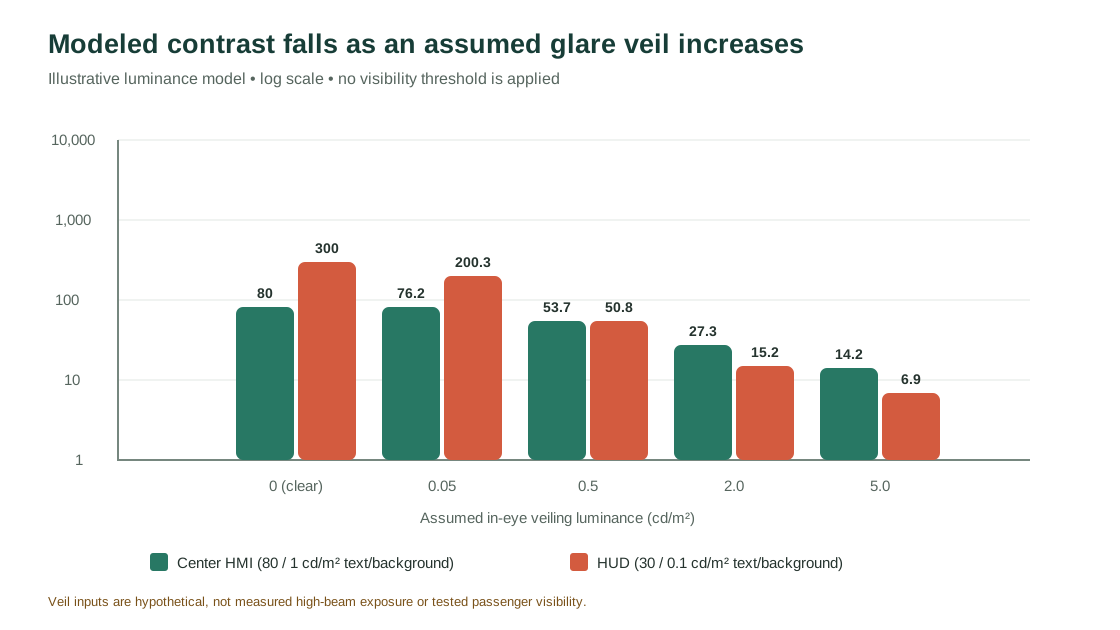
The “high-beam” cases are hypothetical veil levels. They are not derived from a real headlamp, windshield, eye position, or lighting instrument. The calculation omits visual adaptation, light spectrum, pupil size, glare angle, display reflections, aging effects, and individual vision differences. It shows how sensitive the assumed display contrast is to added stray light; it does not predict whether a passenger will see or understand the alert.
Design Implications
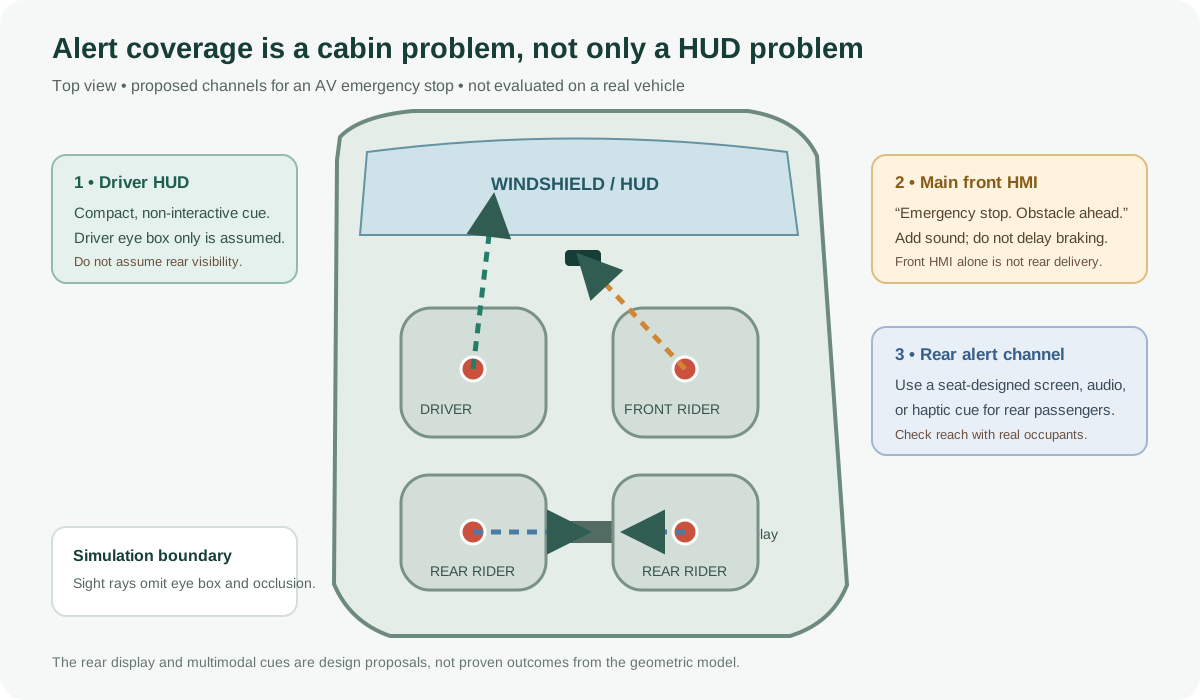
Do not treat the HUD as a cabin-wide screen
Use the driver HUD for a brief, non-interactive cue only when it supports an active driver or fallback role. Do not assume rear passengers can see it.
Give the rear row its own alert path
Consider a rear display, audio, or haptic cue designed for back-seat occupants. Check it from each seat and with normal head movement.
Keep emergency content brief
“Emergency stop. Obstacle ahead. Vehicle braking.” is a proposed message, not a tested phrase. Avoid route cards, chat, text entry, and preference sliders during the event.
Control night glare without hiding the warning
Evaluate ambient-light dimming, dark noncritical backgrounds, bounded brightness control, and windshield reflections while preserving warning conspicuity.
NHTSA Guidance and Study Boundary
NHTSA's driver-vehicle-interface guidance recommends minimizing glare from and onto displays. Its suggestions include automatic or adjustable dimming in darkness, dark backgrounds, and reducing window reflections. It also warns that placing noncritical information farther from forward gaze to reduce display glare is not appropriate for critical safety messages. Read the NHTSA Human Factors Design Guidance.
NHTSA's voluntary visual-manual driver-distraction guidance uses human eye-glance and visual-occlusion procedures. The eye-glance criteria depend on participant measurements, including mean glance duration and total eyes-off-road time. This Python model has no eye-glance data and cannot pass or predict those criteria. Also, driver-focused guidance does not certify whether a passenger alert reaches a rear-seat occupant. View NHTSA's visual-manual guidelines and test procedures.
Next Study
The next step is to replace assumed inputs with an actual cabin mock-up or simulator. Measure display luminance and reflections with a photometer, test HUD visibility inside and outside the driver eye box, and test alert detection and comprehension from front and rear seats. If a front-seat participant has a driving or takeover task, collect eye-glance measures using an applicable NHTSA procedure. Analyze passenger alert reach separately from driver distraction.
Contribution
This case study is exploratory. It reports no human-participant results and makes no claim of NHTSA compliance or vehicle safety validation.