
Who Shapes an AI-Assisted Decision?
Protected dissertation research
Dissertation Study 3
This case study contains ongoing dissertation work. Enter the shared password to view the full project.
Generative AI / Decision Authority / Mixed Methods
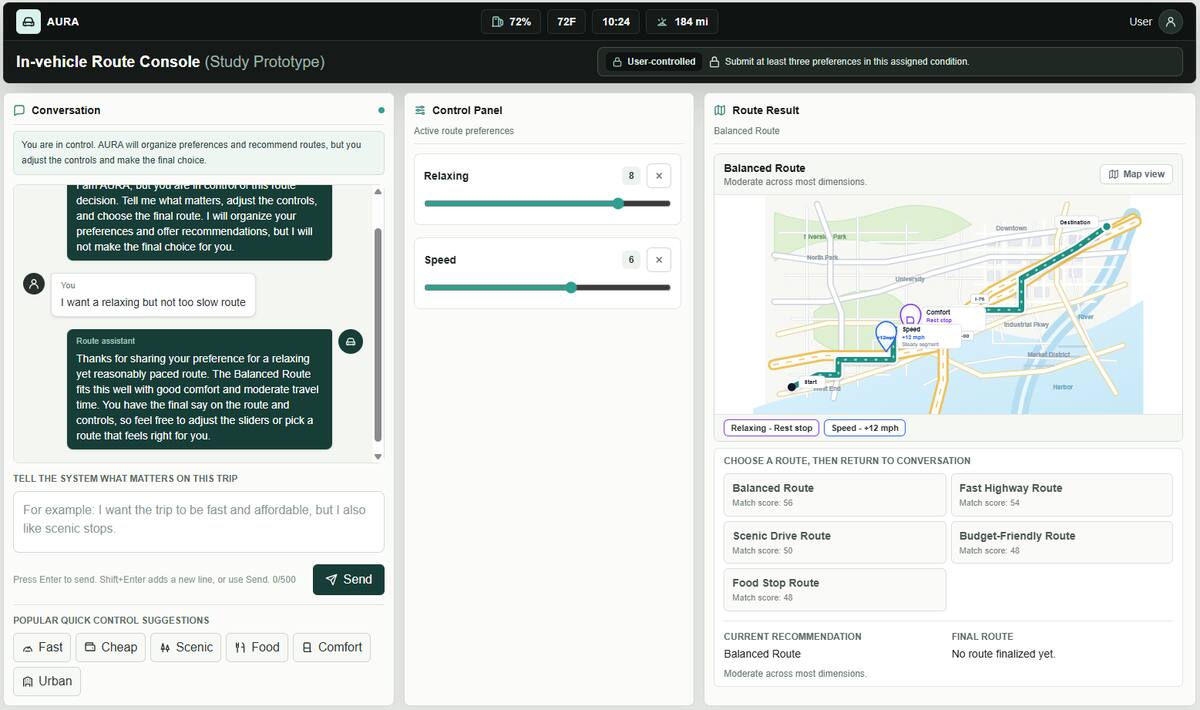
I designed AURA, a generative route-planning interface, and used it to study how AI shapes a decision before and after the available options are created.
Project Objective
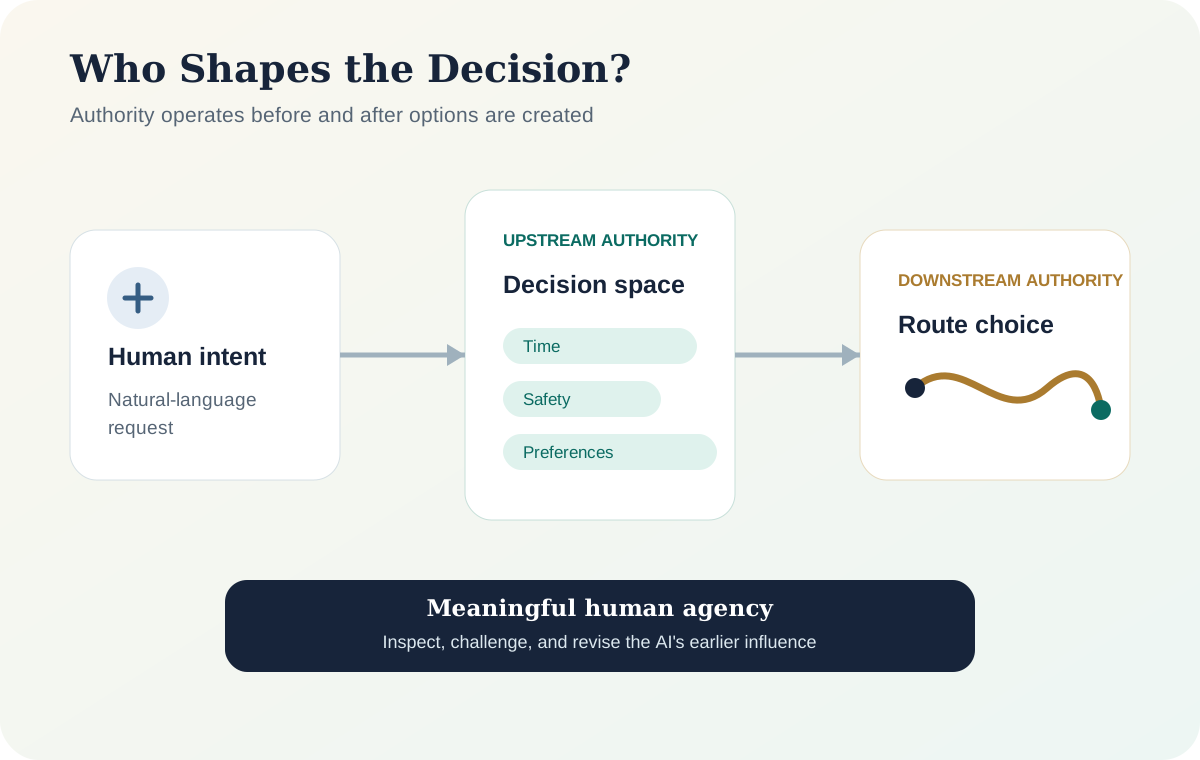
AI can influence a decision before it recommends an answer. It can decide how a person's request is interpreted, which factors matter, and which options become available. Giving a user the final choice does not remove this earlier influence.
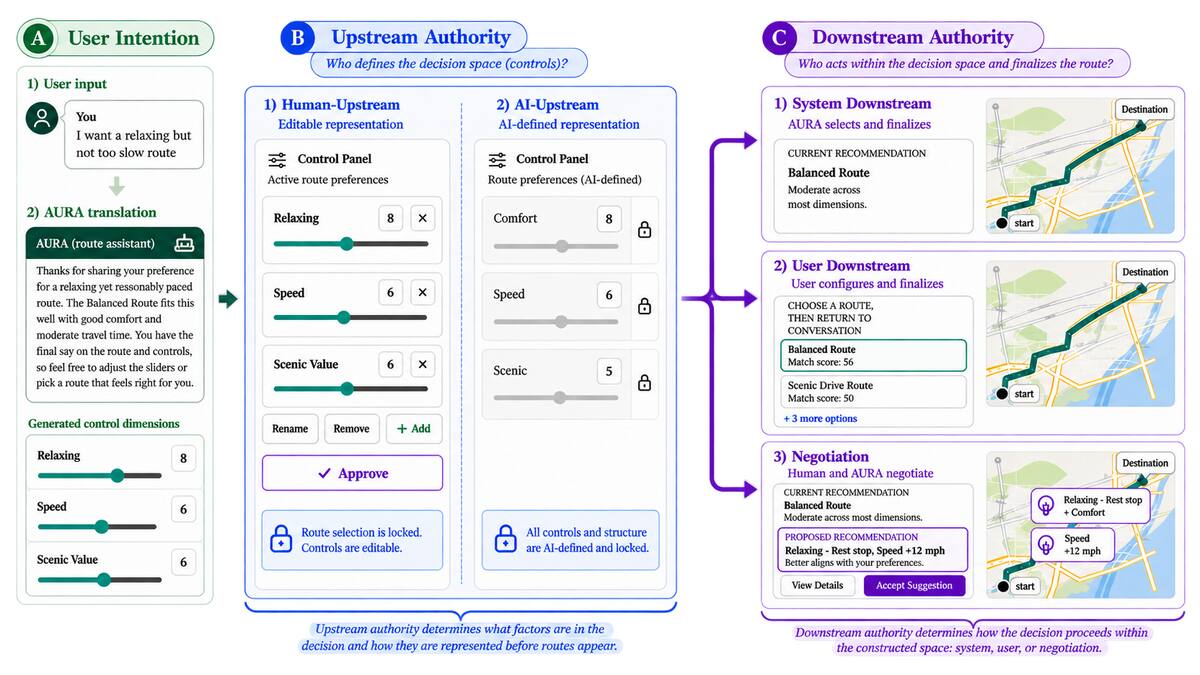
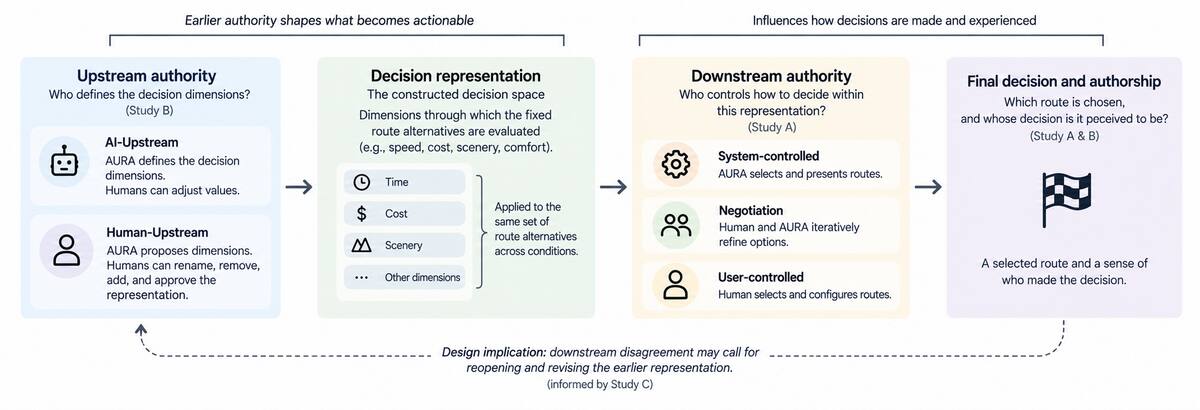
The project examined two layers of authority: who defines the decision space and who acts within that space.
Research Timeline
* Approximate active project time. Expedited IRB review was the main calendar driver.
AURA Prototype
AURA turns a passenger's natural-language route request into an interactive set of decision factors and route options. The prototype made it possible to change who could shape the decision representation and who could make the final route choice.
Method Alternatives and Choice
Alternative: Final-choice experiment only
Testing only who selected the final route would measure downstream control, but it would miss the earlier authority used to define the factors and options in the decision space.
Alternative: Survey vignettes
Vignettes could compare many situations quickly, but they would provide limited behavioral realism because participants would not build, inspect, revise, or negotiate an actual route decision.
Alternative: Interviews only
Interviews would provide rich explanations of agency and authorship, but they would not isolate how upstream and downstream authority changed choices and perceptions.
Chosen: Prototype, experiments, and interviews
This was the best fit because the working AURA prototype made authority visible and manipulable, the experiments tested effects, and interviews explained how participants understood control and authorship.
Three Connected Studies
Study A: Downstream authority
Tested how system choice, user choice, and negotiation changed the decision path and final route.
Study B: Upstream authority
Tested whether people could inspect and revise how AURA represented their request.
Study C: Authority in practice
Used interviews to examine how participants understood influence, control, and authorship.
Mixed evidence
Combined interaction logs, route outcomes, questionnaire data, and thematic analysis.
Study Figures
Two Layers of Authority
Authority over the decision space
Who decides how the user's request is translated into goals, constraints, and options?
Authority within the decision space
Who compares the available options, negotiates tradeoffs, and makes the final choice?
Whose decision does it feel like?
People may still experience authorship when they recognize their intentions in the AI's contribution.
What can the user reopen?
Meaningful control may require revising the AI's earlier interpretation, not only changing the final option.
Evidence
Key Findings
Design Recommendations
Show how the request was interpreted
Let users inspect the goals, constraints, and assumptions created from their input.
Support upstream correction
Allow users to revise the decision representation before comparing final options.
Make authority transitions visible
Clearly show when the AI recommends, negotiates, decides, or returns control.
Measure authorship separately from control
Ask whether users recognize their intentions in the outcome, not only whether they clicked the final button.
Broader Product Relevance
The framework applies beyond route planning. AI tools in healthcare, finance, hiring, education, and productivity also shape how a problem is represented before offering a recommendation. Product teams should give users ways to inspect and revise that earlier influence.
Dissertation Study 3 of 3. Part of Understanding Human-AI Relationships in Autonomous Vehicles.